Photobucket

an Art Critic is a person who is professionally engaged in the analysis & interpretation of works of art

an Art Movement is a specific art style with a philosophy followed by a group of artists during a restricted period of time

a Critique is an article or essay criticizing a literary or other work; detailed evaluation; review

an Aficionado is a person who likes, knows about & appreciates a particular interest and fervently pursues it

an Escort is a person who under their protection, care, or safeguard accompanies another on a journey, not Berlusconi's definition

20 June 2011

art time lines


Here we start with a very simple art history concept above. Next we gently glide and slide you in further. The theories and style are in masses. 

I personally have settled into the MODERN ART PERIOD and forward as my specialty and are of profound studies. Being at the moment in a relapse with my illness, XMRV + and CFS, when I feel better, I am going to create an art timeline that better handles some outside world events and attitudes.


07 June 2011

MOMA’S QUESTION: Does an artist's personality effects our way of thinking about their art?


The morning after the moment that changed my life...


YOUR ART ESCORT'S RESPONSE:
Absolutely … YES. When I first approached art school, I did not like Van Gogh’s art work. I could not figure out why he was so important and why all these other guys were important too. The old cliché, “My kid could paint better that.”

I felt safe enough with this one teacher to tell her how I really felt. She was clearly a mature woman and I was too, going back to school for art around 40ish. Barbara, my teacher explained it’s what we learn about their lives that make us so convicted or compelled to move emotion within ourselves.
Over the next few years I set out on adventure, to reach this point of personal comprehension of why what appears to be sometimes just outright ugly art becomes a master piece.

Where it led me I never thought I would have gone. What I saw and personally experienced during this 2 years period would be so consuming that reading and learning about artists who had suffered seemed my only way out.
During this extended period of HELL, with suicidal ideation, the life stories of other artists was one of my saving grace, and the care taking of my 20 year old to lead my life for me for a while...

It’s sort of funny now that adding then another two years of trying to climb out of hell with multiple therapies and rehabs, the one I wrote my own prescription for… turned out to be the one that has shaped the reconstruction of my new  life.
I became intimate with so many international artists and settled in on my love for the modern art movement as my favorite. The impressionist pieces prior to my illness could not satisfy my hunger or squelch my thirst.

It was the artists’ details of their lives, what made them tick? Why they needed to be driven to paint something that would never sell but they kept doing it. What kept them from the edge of suidice or let them fall to succumb?

Now when I see works that I like, or that are different, weird or just ugly, I research the artist’s life deeper than others to see if I can see what I can find. To see how I may have aligned myself with whom they were expressing themselves to be. 
now are your all wondering what the hell happened to her that she write such crazy nonsense, knowing the depths of hell?

Sept 2006
Informed I have 1 to 3 months before my heart valve blows, 
Oct 15, 2006
Legal divorce is finalized, my little daughter is 5 years old

Nov 6, 2006
Open heart surgery mitral valve repair

Dec 5, 6, 7, 2006
Suffered 3 mini strokes, one each day

Dec 13, 2006
Suffered Ventricular Tachycardia or VTAC for short

Dec - April 2006 Coumadin resistant needing multiple blood draws every week, arm veins scarred and collapsed 

Dec 26, 2006
Entered a multiple year phase of suicidal ideation

Jan 2007
Body Memory Flashback started raging for 9 months

May 2007
Diagnosis of Complex Post Traumatic Stress Disorder

Nov 2007
Amnesia broke and night terrors started for 6 months

June 2008
The bombing stopped and it was a wait and see

Aug 2008
The first therapy started for stroke rehab. Progress was slow at best

Jan 2011
Chronic Fatigue Immune Disorder was diagnosed and a whole new treatment plan was started

April 2011
Started an experimental drug for my CFS neurological brain virus attacking my auto immune system

June 2011
Registered for a MOMA online course… to help gather, organize and make sense of the past 4 years of my life through other artist’s stories and suffering

MOMA AND MODERN ART

REPRINTED FROM: MOMA
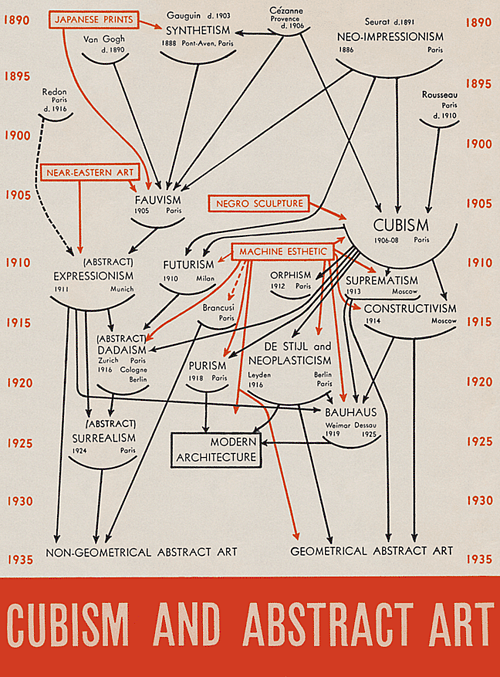
Alfred H. Barr, Jr., 1930. The Archives of The Museum of Modern Art, Chart of Modern art

video about women in MoMA's early history with commentary by Michelle Elligott, Museum Archivist.

ALFRED H. BARR, JR., AND THE MUSEUM OF MODERN ART
The Museum of Modern Art was founded in 1929, and from the beginning to the present day it has been the foremost museum of modern and contemporary art in the world.

Alfred H. Barr, Jr.
The Museum's founding director, Alfred H. Barr, Jr., was only 27 years old when he took the post. He had previously designed and taught the first modern art course in the United States, at Wellesley College in Massachusetts.

The Museum started out in 1929 in a few rented rooms in a midtown Manhattan office building at 57th Street and Fifth Avenue. In 1939, just 10 years after the stock market crash of 1929, the Museum was transferred to a new building on 53rd Street between Fifth and Sixth Avenues.

From the very beginning, Barr wanted multiple departments, so he established the first art museum departments of photography, cinema, architecture, and industrial design.

In 1933, Barr drew his "'Torpedo Diagram of Ideal Permanent Collection" to suggest that the collection moved like a torpedo through time, with its nose representing the present and its tail being the past. The goal was to have most of the collection focus on the early part of the 20th century.

For the cover of the Cubism and Abstract Art exhibition catalogue in 1933, Barr designed his famous diagram charting the "isms" that preceded, coincided with, and followed World War I. The art historian Robert Rosenblum wrote in 1986:

Amazingly, even now ... Cubism and Abstract Art maintains its fundamental authority. ... Barr's text survives to this day in a strangely timeless and undated way, a combination of historical chronicle with an unfailing ability to single out that work of art whose description will make the most salient points. ... This level of distilled excellence is so consistent that, for the past half-century, most scholars have been refining, amplifying, or diluting Mr. Barr's initial presentation of the Gospel of modern art in 1936.

With our class, we will examine many of these "isms" and look at their relationships to each other. Each week, one main artist will be used as a lens to focus our understanding of key concepts.

Francesca Owens, American Artist, has chosen Spoleto as her home, she is also a talented art critic!


REPRINTED FROM: SPOLETONLINE

Translated from Italian to English
Written by: Sandro Morcihelli 
As a host of Spoleto, a well-known Italian-American artist resides her in our historical center from New York City and Colorado. She is called Francesca Owens and has already put in evidence for some of her successful exhibitions in Italy, with particular reference to city Etruscan Cortona, where has a clear reputation. Her work has been presented in America in numerous states, where her paintings representing high-level which were enthusiastically received, as known critics have written, that have focused on excellent technique combined with color Brilliant, immediately strike the eye of the visitor.

www.francescaowens.com
 her website includes wild animals and particularly savage, like the tiger, leopard, jaguar and lion. Not for nothing has worked together with famous biologists, who have sincerely appreciate his art, as can be seen from articles signed by famous personalities.

At present, Francesca Owens told us that following an illness that lasted for four years, she devoted herself to criticism of modern and contemporary art, and was also invited by directors American and foreign journals. He also added his criticism of the site Austrian Journal of Tamara de Lempicka for a show that is still held in Rome in Victorian, can be read here at Tamara’s official website.

Canada and Austria, the United States and in Italy, has popularity, having been placed in evidence for its intense activities is considered very useful against a painting that can be defined as alive and real, not suffering any contamination.

For the immediate future, Owens will participate in some important "Seminars", putting at the disposal of young talent and schools that wish to be able to learn from the voice of an artist everything that is known only in a unsatisfactory and or skims the surface.

It should also be noted that our Francesca has a real archive of art books, DVDs, CDs and even toys table to educate modern art. 
FRANCESCA OWENS AN AMERICAN ARTIST, AS HER HOME HAS CHOSEN SPOLETO. She also is a talented art modern critic. We intend to come back at the next Festival of the 2 Worlds, when our cities will be These Art Critics not only from Italy.

Photograph by Cesare Cestari of the Torre del Greco, near Naples 

06 June 2011

Your Art Escort's response to Dott. Rosa Maria Letts of London commentary on Sgarbi


First is the attempt to understand the definition of the CONTEMPORARY ART MOVEMENT and all that may be included in this concept. 

Second is the discussion of SGARBAGING, excuse me, I meant say, an understanding of some of the unfair trade practice or art poaching techniques of VITTORIO SGARBI.

Third is that the MAXXI National Museum of 21st Arts in Rome is for the art of the 21st century, not “20th century”.  

Fourth is the concept of “Can we agree to disagree?”, which is not permitted in the “world according to Sgarbi”.

Since we are limited to 1000 words here, only half of one point will arrive here and that is where I shall start. The other 3 points will need to be reviewed at a different time.

For now I will address the 1st point hyperlinking my footnotes to support my social discussion and art commentary/critique.

Contemporary Art, (which I am NOT a huge fan of, so let’s get that out on the table) can be defined as art produced at this present point in time or art produced since WorldWar II. Examples of international contemporary museums and international contemporary artists in this movement are numerous and well established outside of Italy.

To use the term, “ephemeral” may sound trendy, chic, cutting edge or “to look smart” but is without merit when applied too loosely to one movement as a mutually exclusive event.  To apply this word to any one specific art movement alone is not accurate, unless you are willing to look back over the entire history of art and see that. THIS WORD is part of what art movement is all about.  

That where the idea of “movement” comes from. It is either too narrow to apply to one movement, or possibly is better applied to any of all of the past art movements, as there are so many!

Ten different art movements have been identified to 19th century 
and 37 different styles have been identified for the
20th century. Even a child’s basic attempt at the simple law of averages would have to conclude 100/10 = 10 for the average length of a movement in the 19th century and 100/37 = 2.7 years to the average length of an art movement in the 20th century. But since these periods are NOT mutually exclusive this point of view doesn’t work either.

So the contemporary art movement has been around since World War II, 2011- 1945= 66 years, for example only. To call the works of the contemporary art movement “ephemeral” seems lacking a full grasp of what anything past the modern art movement is about, maybe “transient” movements might be more appropriate.

A sixty-six (66) year history and holding makes a statement, that even for those of us that may not be fans of the contemporary art movement.

Contemporary art is here and has been here and until the next brave group of controversial genius artist arrive pushing and dragging us along, here we lie.

In support of Francesco Bonami statements I agree whole heartily with his professional educated and well-rounded assessments of this clear analogy “Contemp­orary art is to Sgarbi what America is to Bin Laden.”

I also recommend any of you wanting to expand your art education watch this interesting PBS video, ANYTHING IS POSSIBLE for a larger global perspective.

Dott. Rosa Maria Letts of London writes:

REPRINTED FROM the comments section of: Shock appointment of anti-modernist to Venice Biennale,
Critics include Whitney Biennial curator Francesco Bonami who says Italy "deserves Sgarbi" because of its antipathy towards contemporary art.
Comments
27 Aug 10
16:23 CET
Dott. Rosa Maria Letts, London
The appointment of Vittorio Sgarbi both as curator of the Italian Pavilion at the next Venice Biennale and as advisor for acquisitions at the Maxi Museum of modern art in Rome is very good news. Prof Sgarbi is at least one of the most cultured and intelligent man we have on the art scene in Italy. He has organized many important exhibitions and written extensively on Italian Art, Classical and Modern. His opinion is to be valued. He can be controversial but represents many trends and is conscious of our tradition and past supremacy in the sector. Modern Art should be the celebrated art of the 20 century,as opposed to contemporary art still to be proven. Gnoli is an artist he has mentioned - hopefully to enter the Maxi - he is a great artist like indeed De Dominici. But contemporary art should be kept to temporary exhibitions and await to enter the collections until they are accepted as Modern Artists. Much contemporary art is just ephemeral.

Shock appointment of anti-modernist to Venice Biennale

REPRINTED FROM:
Critics include Whitney Biennial curator Francesco Bonami who says Italy "deserves Sgarbi" because of its antipathy towards contemporary art

By Alessandro Martini and Gareth Harris | From issue 211, March 2010 Published online 24 Feb 10

LONDON. The appointment of Vittorio Sgarbi, the celebrity art critic and polemicist, as curator of the Italian Pavilion at the 2011 Venice Biennale and supervisor of acquisitions at Rome’s new MaXXi museum of 21st-century art is dividing the Italian art world, thanks to his well known antipathy to contemporary art.

Sgarbi was the under secretary of state for the ministry of culture from 2001-02 in Silvio Berlusconi’s government. In 2004, Sgarbi founded the Party of Beauty to halt the construction of new buildings in Italian cities. In 2006, he switched allegiance and stood for the centre-left Consumers’ List party.

Appointed as the mayor of the Sicilian village of Salemi in 2008, he is an outspoken television pundit.

The Venice appointment is especially sensitive as Italy celebrates the 150th anniversary of its unification in 2011. Italian culture minister Sandro Bondi defended his choice, insisting that Sgarbi “has in-depth knowledge of Italy’s heritage”.

The appointment has drawn stinging criticism from Sgarbi’s compatriot Francesco Bonami, the curator of this year’s Whitney Biennial, who berates the current Italian government’s attitude to contemporary art.

“Unfortunately we deserve Sgarbi,” he says. “Contemp­orary art is to Sgarbi what America is to Bin Laden.

Once in a while, Sgarbi, like Bin Laden, rants against his enemy. I have to say that Sgarbi’s joint appointment is very close to a suicidal attack on Italy’s dignity,” Bonami told The Art Newspaper.
Sgarbi has indicated how he will approach the Italian Pavilion: “I’m considering an empty pavilion that only contains an address book of Italian artists. I may also just include a single artist such as Saturnino Gatti, a 15th-century master who has been erased from art history, making him really contemporary. But in my ideal pavilion, I would like to install just one work, the Dead Christ by Mantegna [around 1480] next to a photograph of Che Guevara on his death bed.”

MaXXi
Meanwhile, Sgarbi has outlined his direction for the collection of the MaXXi, the national museum of 21st-century art, which is due to open this spring, telling our sister paper Il Giornale dell’Arte that he does not rule out a selection of Arte Povera artists but “alongside, in a so-called national collection, we should acquire works by Carol Rama, Giuseppe Pinot-Gallizio, Sergio Saroni and Ottavio Mazzonis. And if we have Maurizio Cattelan and Vanessa Beecroft we should also have Domenico Gnoli, Fabrizio Clerici and Carlo Guarienti.”

“I believe that the MaXXi should concentrate on the generation in its fifties. The criterion should not be whether something is traditional or not—I want Antonio López García and Lucian Freud in the collection. The main point is, we are in Italy and our museum should be different from museums in London and New York,” he added.

But Bonami again raised concerns about the development: “Since 1999, the MaXXi has had a headless acquisition policy. The collection is a mediocre accumulation of late 20th-century art. The opening show, curated by Achille Bonito Oliva, will focus on Gino De Dominicis—you could not get an exhibition that is more 20th-century. They are going backwards. I don’t understand how the president of the MaXXi Foundation [Pio Baldi] and the curators can maintain their dignity. 

They have mismanaged MaXXi and Sgarbi is the natural consequence.”
A museum spokeswoman em­phasised, however, that Sgarbi has been appointed in an advisory role. 


“Sgarbi will not directly acquire works. The directors of the two MaXXi museums—Anna Mattirolo, director of MaXXi Arte, and Margherita Guccione, director of MaXXi Architecture—propose all acquisitions.” She also pointed out that the De Dominicis show is one of five planned for the inauguration.

The museum, des­igned by the Iraq-born architect Zaha Hadid, was originally scheduled to open in 2006. The E150m project was first mooted in 1997 but various obstacles, such as shortfalls in government funding, have delayed the scheme. The E10m annual running costs will be partly provided by the ministry of culture. The institution has so far acquired more than 300 works, ones by Italian artists such as Alighiero Boetti, Mario Merz and Giuseppe Penone, as well as work by non-Italians Anish Kapoor, William Kentridge, Gerhard Richter and Andy Warhol.

But Sgarbi says that “works have been bought at prices that are completely inconsistent with [the usual] museum acquisition rates. These prices have definitely been inflated.”

He also criticised the appointments of Baldi, Mattirolo and Guccione, saying that they were “shoo-in” candidates, prompting the MaXXi spokeswoman to say: “The trio have worked with conviction on the MaXXi project since its inception, with excellent practical results.”